
"The only limit to our realization of tomorrow will be our doubts of today."
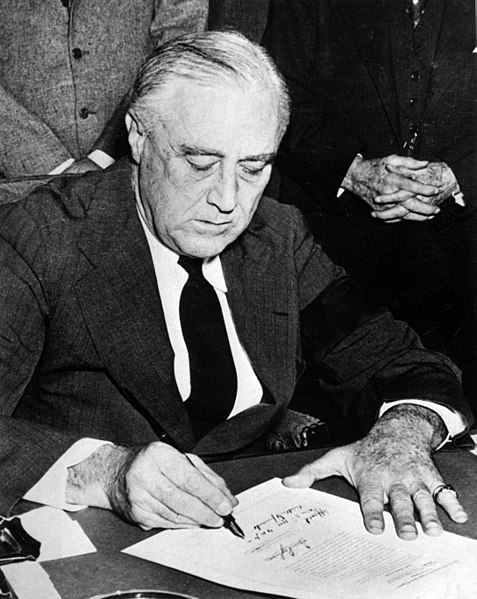
(Right: President Roosevelt signing the declaration of war against Germany.)
(Above: Japanese family waiting for evacuation.)
Franklin Delano Roosevelt, the 32nd President of the United States, led the country through the Great Depression and World War II. He was an elected leader, the President of the so-called “free world,” and was, along with Winston Churchill and Joseph Stalin, a key leader of the Allied forces. Roosevelt was a strong and steady leader; the fact that he was elected to more terms than any president before or since, with four terms, evidences the American people’s faith in him. He was primarily a military, economic, and social leader.
In terms of leadership power, FDR used the federal government to its maximum extent. Economically and socially, through the New Deal, an unparalleled social agenda that sought to slow or reverse the effects of the Great Depression, Roosevelt established countless “alphabet soup” organizations—the TVA, NRA, PWA, and AAA to name a few. These federal agencies, especially the PWA (Public Works Administration), used immense amounts of federal dollars to create the largest dams, power stations, and agricultural reforms in history. Militarily, Roosevelt entered our country into World War II as a response to the United States being “suddenly and deliberately attacked by naval and air forces of the Empire of Japan” (from his famous “Infamy Speech”). Once fully engulfed in the destructive and intense conflict, Roosevelt worked with Churchill and Stalin to stymie Hitler’s terrifying encroachments on more and more European countries. The Allied assaults on the Axis forces (most of the heavy lifting actually done by Soviet forces) successfully destroyed the Nazi Party and its armies. This victory is probably the clearest example in modern history of true good winning out over true evil.
My favorite characteristics of President Roosevelt are his dedication to social reform, realistic nature, and friendliness. Without an undying tenacity to actually change the country permanently, Roosevelt’s huge initiatives would have fallen flat within a few months. However, some of the federal New Deal agencies, such as the Tennessee Valley Authority, still exist and still work. Although he was optimistic about the future, Roosevelt was realistic. He knew that the country was in the worst economic state it had ever been in (1933, when he first took office, was the worst year of the Depression), and that Hitler was a very real and powerful adversary. He told the American people these hard facts, not as scare tactics to get reelected, but because they were the truth. Similarly, his now-famous Fireside Radio Chats were exactly that—he sat by his fireplace and talked, through the radio waves, directly to the American people. In this sense, many Americans felt a personal connection to the man occupying the federal office that other times was seen as one of an aloof figurehead (such as “Silent” Cal Coolidge).
But, like any man, Roosevelt had his flaws. Some say they were serious enough to mar his entire presidency, but I’m a little less harsh on him. The two main scandals that plagued Roosevelt were the “court-packing scheme” and internment camps. Since FDR had high-minded and incredibly huge federal plans to solve the Great Depression, much federal money and time was invested in his New Deal. However, conservative Supreme Court justices consistently challenged—somewhat rightfully—the constitutionality of FDR’s wide-reaching government initiatives. Surely the founders did not intend for Presidents to have such an outsize influence on the economy and social atmosphere of America, but they also did not intend for a Great Depression to occur. FDR’s solution to his problems with the Supreme Court was to appoint a young helper to all of the (mostly old) conservative justices. This was seen as a “court-packing scheme,” since FDR’s appointees would have likely agreed with him and advanced his agenda further. Obviously, this overstepped any president’s bounds. The internment camps also came to define Roosevelt criticisms. Executive Order 9066 forcefully relocated Japanese-Americans out of misguided fears of domestic terrorism plots; later, suspicious Germans and Italians were also interned. The comparisons to Hitler’s concentration camps do not quite hold up, but the internment camps were still an overreaction and an inhumane way to treat American citizens.
Images from: Archival Research Catalog of the National Archives and Records Administration

I've always found FDR to be one of the most polarizing figures in America's history. The ability he had to rally support for his causes is truly astounding when you think about it. I think what I like the most about him was he wasn't afraid to try anything. While some of his new deal plans didn't always succeed he knew that something was better than nothing. When it came to war, he was not afraid to send the troops once the US was attacked.
ReplyDeleteThere's no debating that he made vast increases to the scope and size of the national government. But he also was responsible for the emergence of America as a global power.
Going to high school in Ecuador, you can imagine how big of a deal it was for us to learn about FDR; however, I mostly knew him in the context of the World War. Great, informative post.
ReplyDelete